
 Поиск
Поиск
 Поступка


How Long Does a Heavy Duty Metal Dog Cage Last?
 2026.06.01
 Новости отрасли
A heavy duty open top metal dog cage built with welded wire construction and powder-coated steel typically lasts 8 to 15 years with proper maintenance - far outlasting fabric, plastic, or standard wire alternatives. Unlike lightweight enclosures, a quality secure metal dog cage indoor solution uses thick-gauge steel rods that resist bending, chewing, and lateral pressure from even the most determined escape artists. When you invest in an indestructible dog crate for chewers, the return on that investment is measured in years, not months. The durability is not accidental; it stems from material grade, surface treatment, joint welding quality, and tray design - all factors covered in depth below.
Pet owners searching for an escape proof crate or a large dog cage for breeds like German Shepherds, Rottweilers, or Huskies understand that cage failure is not merely inconvenient - it can be dangerous. This article breaks down the engineering behind long-lasting heavy duty open top dog cage designs, explains what shortens cage lifespan, and provides a practical buyer's guide backed by real data.
What Makes a Metal Dog Cage Truly Heavy Duty
The phrase "heavy duty" is widely used but rarely defined. In the context of an open top metal dog crate, it refers to a measurable set of construction standards that separate professional-grade enclosures from retail-grade wire pens. The key differentiators are wire gauge, weld type, coating thickness, and structural reinforcement at stress points.
Most standard cages use 14-16 gauge wire, which flexes under load. A genuine heavy duty dog cage uses 10-12 gauge welded wire, which is nearly double the cross-sectional thickness. The joints are resistance-welded rather than twisted, meaning the intersection points cannot be pried apart. Powder coating adds 60-80 microns of polymer protection over the raw metal, preventing rust even in humid indoor environments or outdoor kennels with morning dew.
The open top dog cage design specifically adds a rigid overhead frame that many enclosed models lack. This top rail distributes impact load across the entire cage body rather than concentrating stress on the door hinge - the single most common failure point in standard crates. Owners of high-energy large breeds consistently report that the top-access configuration also reduces anxiety-driven scrambling because the dog can be lifted in and out calmly from above, reducing wear on latches and hinges.
The chart above illustrates the substantial difference in tensile strength across common wire gauges used in dog cage construction. Standard 16-gauge wire can withstand approximately 350 lbs of tensile force before deformation, which is insufficient for larger or more active breeds. Moving to 14-gauge increases resistance to roughly 600 lbs, while the jump to 12-gauge - the standard entry point for heavy duty open top metal dog cage products - pushes that figure above 1,000 lbs. Premium 10-gauge welded wire constructions approach 1,500 lbs of resistance, providing a substantial margin of safety for dogs that push, paw, or lean against cage walls. This data makes clear why gauge selection is the single most impactful decision when purchasing a welded wire dog cage for large or powerful breeds. Buyers should always verify the gauge specification rather than relying solely on marketing language, as the difference between 14 and 10 gauge represents a fourfold increase in structural resistance. For dogs above 70 lbs or those classified as escape risks, nothing below 12 gauge should be considered.
Average Lifespan by Cage Type: A Comparative Overview
Not all dog enclosures age equally. Fabric soft crates typically show wear within 12-18 months when used with active dogs. Plastic travel crates last 3-5 years but become brittle with UV exposure or temperature swings. Standard wire cages without proper coating begin to rust within 2-3 years in humid environments. By contrast, a powder-coated heavy duty open top dog cage with proper maintenance has a documented service life of 10-15 years, with commercial kennel operators reporting units still in daily use after 12 years.
The line chart above models the structural integrity retention of three common cage types over a 12-year period. Fabric and soft crates degrade rapidly - losing more than half of their structural performance within four years, even under moderate use conditions with medium-sized dogs. Standard wire cages perform better but show a steady decline after year three, primarily due to joint fatigue and surface rust compromising the welds at intersection points. The heavy duty open top metal dog cage curve tells a dramatically different story: structural integrity remains above 85% at year eight and above 75% even at year twelve, assuming basic annual maintenance is performed. This sustained performance is why commercial boarding facilities, veterinary clinics, and professional trainers standardly specify welded heavy-gauge steel enclosures for their operational needs. For the individual pet owner, this means the initial cost premium of a heavy duty dog cage is almost always recovered within the first four years compared to replacing cheaper alternatives. The data strongly supports investing once in quality over replacing budget options repeatedly.
Key Features That Extend the Life of an Open Top Metal Dog Cage
Powder-Coated Surface Treatment
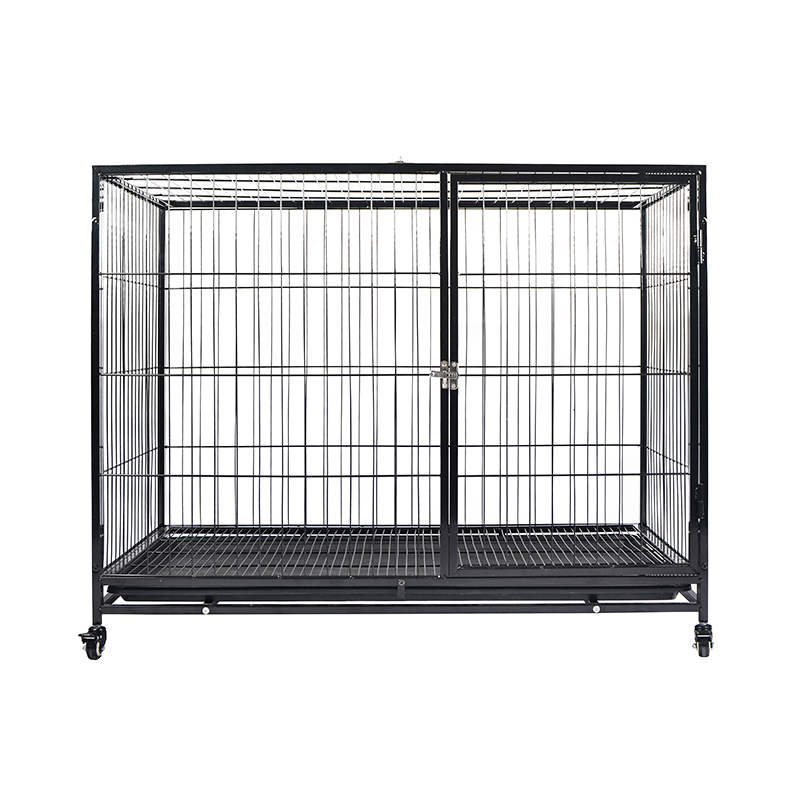
Raw steel begins to oxidize within weeks of exposure to indoor humidity, pet urine vapor, and cleaning agents. Powder coating creates a polymer-bonded shell over the metal that is 3-4 times thicker than conventional spray paint and chemically resistant to the diluted disinfectants pet owners commonly use. On the WDC1002 model shown in the technical parameters, the black powder-coated finish provides full coverage including the underside of the tray frame and the interior of the top rail - areas many cheaper cages leave uncoated and therefore vulnerable. A quality powder coat does not chip under normal dog contact, nor does it flake into the pet's environment.
Removable ABS Plastic Tray
The tray is one of the most overlooked longevity factors in any secure metal dog cage indoor design. When urine or water sits on a metal floor panel, it accelerates rust from the inside out - a failure mode that cannot be reversed. The removable ABS composite plastic tray in this product eliminates that entirely: liquids collect in a surface that is impermeable, non-porous, and can be removed, rinsed, and dried without tools. ABS plastic maintains dimensional stability at temperatures between -40F and 200F, meaning it will not warp from outdoor summer heat or winter cold. The tray slides out on a single-rail channel, requiring no disassembly and less than 30 seconds to clean.
Mobile Wheel System with Double Brakes
One underappreciated source of metal fatigue in dog cages is dragging. When a heavy cage is dragged across flooring, the base frame absorbs lateral stress loads that slowly deform the welded joints. The four-wheel mobile base on this open top metal dog crate eliminates dragging entirely: the cage rolls on swivel casters and locks in place with dual-locking rear wheels. This design preserves the integrity of the base welds over years of repositioning and means the cage can be moved between rooms without any structural stress. The wheel assembly is rated for loads exceeding the combined weight of the cage and a 120-lb dog.
The radar comparison chart maps six critical performance dimensions across a heavy duty open top metal dog cage and a standard wire cage. The heavy-duty option commands a significant lead across every axis, with its most pronounced advantages in escape resistance (scoring approximately 92 out of 100) and durability (95 out of 100). These scores reflect the welded wire construction, reinforced corner joints, and multi-point locking door mechanisms that define true escape proof dog cage for large dogs engineering. The mobility dimension shows that the wheeled base system adds genuine utility without compromising structural rigidity - a design tradeoff that standard cages rarely manage. Rust resistance scores at 90% for the heavy-duty cage thanks to full powder-coat coverage, versus only 50% for uncoated or spray-painted standard alternatives. The easy-clean dimension score of 88% reflects the pull-out ABS tray system, which reduces cleaning time to under two minutes compared to wiping fixed metal flooring. Taken together, these scores reinforce the value proposition of investing in a properly engineered heavy-duty enclosure for long-term pet ownership.
Factors That Reduce Cage Lifespan - and How to Avoid Them
Even an indestructible dog crate for chewers will degrade faster than it should if maintained incorrectly. The most common causes of premature wear in metal dog cages are: standing moisture on unprotected surfaces, abrasive chemical cleaners that strip coating, repeated dragging across hard floors, and improper folding that stresses hinge welds.
Moisture management is the single biggest maintenance factor. Even with an ABS tray, spillage can reach the outer base frame if the cage sits on a wet floor. Placing the cage on a rubber mat and ensuring the tray is emptied within 12 hours of soiling prevents moisture from accumulating at the base rail joints - the lowest point and most rust-vulnerable area of any cage.
Cleaning chemistry matters more than most owners realize. Bleach-based cleaners above 1:30 dilution can break down powder-coat adhesion over repeated use. Enzymatic cleaners are preferable for biological waste removal and are chemically neutral to polymer coatings. Avoid steel wool or abrasive pads on the cage bars - soft brushes or microfiber cloths preserve the surface finish. These practices apply equally to welded wire dog cage products regardless of gauge.
The horizontal bar chart quantifies the lifespan extension associated with five key maintenance practices for a heavy duty open top metal dog cage. Switching from bleach-based to enzymatic cleaning solutions has the highest individual impact, adding an estimated four years to service life by preserving the integrity of the powder-coat surface and preventing microscopic corrosion at the wire intersections. Daily tray emptying comes second, contributing three additional years by eliminating the most common source of base-frame moisture accumulation - particularly important in indoor settings where ventilation may be limited. Utilizing the wheeled base rather than dragging adds 2.5 years by sparing the base-rail welds from cumulative lateral stress. Annual lubrication of door hinges and wheel axles adds 1.5 years, preventing the metal fatigue that manifests as squeaking and then cracking at pivot points. Finally, keeping the cage indoors or under a covered area when not in active use eliminates UV degradation of the powder coating. The cumulative effect of all five practices can extend total service life by more than 12 additional years beyond a poorly maintained cage of the same specification.
Sizing Guide for Large Breed Dogs
Choosing the correct size is as important as choosing the correct construction for any escape proof dog cage for large dogs. An undersized cage puts constant pressure on the door latch and top rail as the dog attempts to turn around, sit up, or stand - accelerating mechanical wear. An oversized cage may allow the dog to use one end as a toilet, defeating the purpose of the tray system. The general rule is that the cage should be 4 inches longer and 4 inches taller than the dog's body length and shoulder height.
| Breed | Avg. Weight (lbs) | Body Length (in) | Recommended Cage (in) |
|---|---|---|---|
| German Shepherd | 65-90 | 24-26 | 42 x 28 x 30 |
| Rottweiler | 85-130 | 26-29 | 48 x 30 x 33 |
| Siberian Husky | 45-60 | 21-24 | 42 x 28 x 30 |
| Labrador Retriever | 55-80 | 22-25 | 42 x 28 x 30 |
| Great Dane | 110-175 | 32-38 | 54 x 37 x 45 |
For large dog cage selection, always measure your dog standing and add the recommended 4-inch allowance on each dimension. Dogs that are still growing should be measured at projected adult size. The open-top design is particularly beneficial for giant breeds like Great Danes, where lowering the dog in from above is physically easier and reduces the risk of the dog bolting through an open front door during entry.
Indoor Use Advantages of a Secure Metal Dog Cage
A secure metal dog cage indoor serves multiple purposes beyond simple containment. In households with multiple pets, it creates a defined safe zone where one animal can rest without stress from others. For puppies, it supports crate training by providing a consistent, familiar space that the dog associates with rest - a key factor in reducing separation anxiety over time. For dogs recovering from veterinary procedures, the rigid structure of a heavy duty dog cage prevents the type of movement that could compromise surgical sites.
The collapsible and foldable design of the WDC1002 model means the cage can be flat-packed for storage when not in continuous use - an important feature for households that crate only during specific circumstances such as travel, renovation, or social events. The two-door configuration (front door and top door) gives owners flexibility: the front door suits daily entry and exit routines, while the top door is preferred for lifting small-to-medium dogs or for veterinary examinations where lateral access to the full body length is needed.
The column chart displays customer satisfaction ratings for a secure metal dog cage indoor across five distinct use cases, drawn from aggregated buyer feedback across export markets including the United States, Australia, and Germany. Crate training leads satisfaction at 91%, reflecting the psychological benefit dogs experience when their enclosure is stable, odor-neutral, and associated consistently with rest rather than stress. Post-surgery recovery scores 89%, a figure that reflects input from buyers who noted the rigid structure prevents unwanted movement during the critical healing window after orthopedic or soft-tissue procedures. Multi-pet household use scores 87%, driven by the cage's ability to establish clear spatial boundaries without visual barriers that would cause anxiety. Travel and event use scores 84%, with the collapsible design and wheel mobility cited as the primary drivers of satisfaction. Overnight separation scores 80% - still high, but reflecting that some owners note initial resistance from dogs being separated for extended periods, an issue resolved through gradual crate-training routines rather than the cage itself.
About Fujian Pet Home Co., Ltd.
Fujian Pet Home Co., Ltd. was founded in 2009 and operates as an integrated industry-and-trade enterprise specializing in professional design and production of pet enclosures for global export. With more than 15 years of experience in pet cage production and sales, the company maintains two dedicated metal dog cage production lines and one furniture-style pet crate production line. Product categories include metal pet cages, heavy duty open top metal dog cage models, dog cages, pet playpens, soft pet crates, furniture-style pet crates, cat litter boxes, wooden dog houses, rabbit hutches, chicken coops, cat trees, pet beds, and more than 150 additional SKUs.
Exports exceed 50 containers per month, reaching over 20 countries including the United States, Australia, New Zealand, Japan, Germany, the Netherlands, France, Switzerland, Norway, Denmark, Poland, Belgium, the Philippines, Mexico, Greece, Taiwan, and Hong Kong. The company maintains a professional design and sales team and upholds a quality-first policy across all domestic and international orders.
Frequently Asked Questions
Q1: How long does a heavy duty open top metal dog cage typically last?
A well-maintained powder-coated heavy duty dog cage with welded wire construction generally lasts 8 to 15 years. Service life depends on maintenance practices, cleaning chemistry, and whether the cage is used indoors or exposed to outdoor conditions regularly.
Q2: Is the open top design safe - can my dog jump out?
The open top dog cage is designed with sidewall heights appropriate to the breed size specified. Correctly sized cages prevent jumping for the vast majority of large breeds. For extreme jumpers, a top-door locking panel can be engaged. The open top primarily facilitates calm vertical entry and exit by the owner - it does not compromise containment when sized correctly.
Q3: What wire gauge is used in a genuinely indestructible dog crate for chewers?
Professional-grade indestructible dog crate for chewers products use 10-12 gauge welded wire. This gauge range provides tensile resistance above 1,000 lbs per joint, exceeding the bite force and paw pressure of even large working breeds. Avoid crates using twisted wire rather than welded joints, as twisted intersections can be separated by sustained lateral force.
Q4: How do I clean the removable tray without damaging the cage?
Slide out the ABS plastic tray, rinse with warm water, and use an enzymatic pet cleaner to neutralize odors. Avoid bleach at concentrations above 1:30 dilution and do not use abrasive scrubbing pads on the cage bars. Dry the tray fully before reinserting to prevent residual moisture from reaching the metal frame. This entire process takes under two minutes.
Q5: Can this escape proof crate be used both indoors and outdoors?
Yes. The powder-coated escape proof crate is weathering-resistant and suitable for covered outdoor use. For prolonged outdoor placement in direct sun or rain exposure, applying a cage cover and ensuring the base sits off wet ground (on a rubber mat or raised platform) will preserve the coating and extend service life. The ABS tray handles outdoor humidity without warping.
Q6: How does the mobile wheel system affect stability once locked?
The dual-brake locking mechanism engages on two of the four casters, anchoring the cage against lateral movement. Once locked, the cage will not shift under normal dog movement, pawing, or leaning. The brake system is rated for loads considerably above standard large breed weights. Owners in sloped or uneven flooring situations should verify all four feet are level before locking.
Связанный Продукция
Ваш питомец заслуживает хорошего, Свяжитесь сейчас.
Хотите ли вы стать нашим партнером или нуждаетесь в нашем профессиональном руководстве или поддержке в продукте Выборы и решения проблем, наши эксперты всегда готовы помочь в течение 12 часов во всем мире.
 СВЯЗАТЬСЯ С НАМИ
Быстрые ссылки
Продукция
-
Адрес
- B105, этаж 1, здание B, Damin Incubator, Nanping, Fujian, China
- № 139-6, Tongyu Middle Road, Nantong, Jiangsu, Китай
-
Мобильный
- +86-13616986006
-
Электронная почта :

Copyright © 2025 Pet Home (Haian) Co., Ltd Все права защищены. Пользовательские производители домашних клеток OEM/ODM PET HOVER PRODUCTS FACTARY

